Friendship Repair Machine
Asymmetric Co-op VR Game // Cross-Media Hardware Installation
"Friendship Repair Machine" is a two-player, asymmetric collaborative installation that maps cross-media game mechanics across physical reality and virtual space. Developed as a speculative therapeutic device by the fictional O.K. Company, the project allows two participants to synchronously navigate and mend fractured autobiographical memories, bridging tangible hardware manipulation with immersive VR level design to reconstruct past emotional narratives.
Technical Pipeline & Architecture
Core Systemic Pillars


PILLAR 01
Asymmetric Narrative Loop
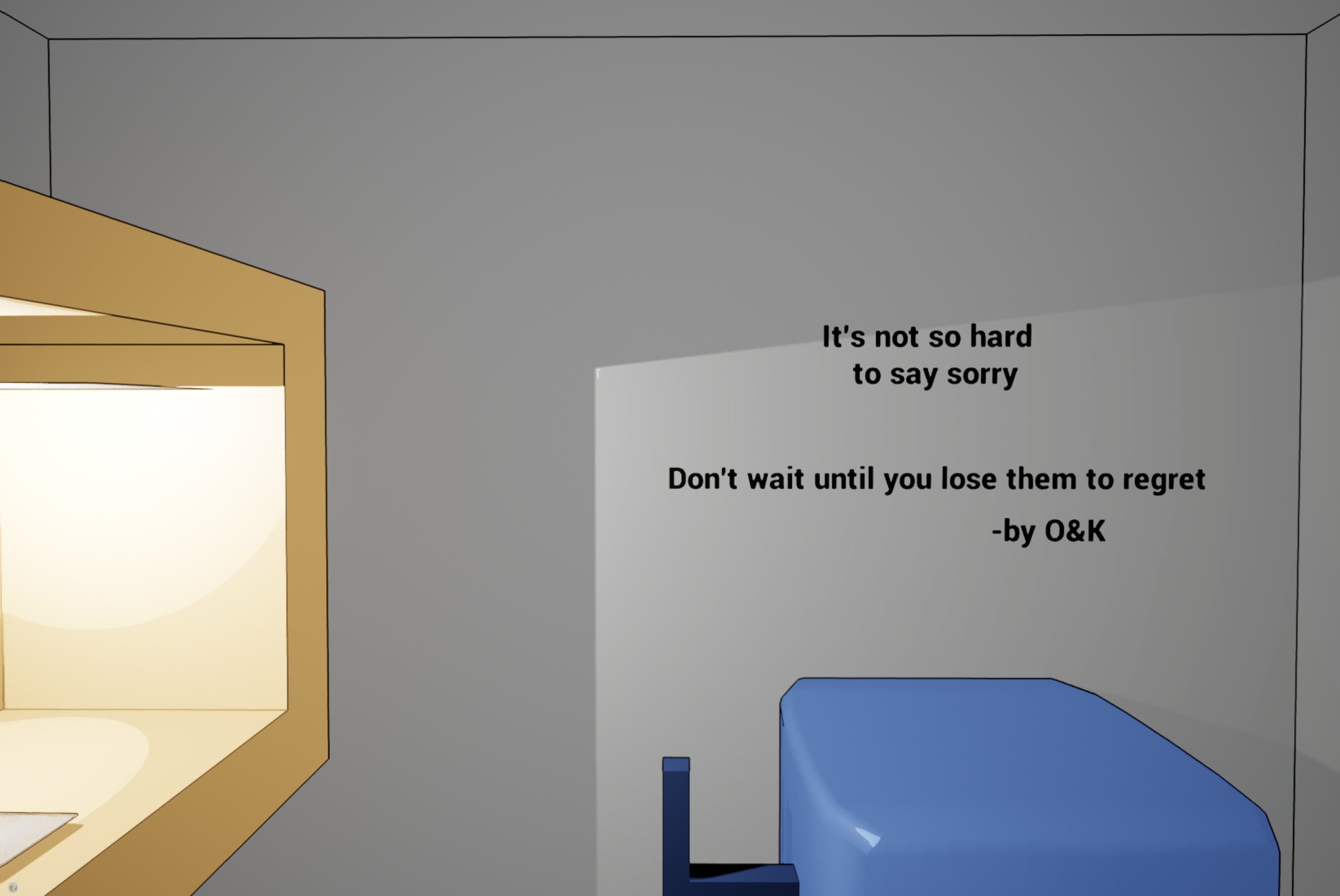
The story background follows an innovative narrative premise: Player A controls a localized physical console as "Andy," while Player B enters a virtual reconstruction of Andy's room as "Bobbie." The space functions as an externalized psychological landscape filled with raw, hidden messages that Andy hesitated to disclose in person twenty years ago.
This framing subverts standard escape-room objectives. The ultimate goal is not geographic escape, but communication. The VR player commands exclusive access to structural visual information and cryptograms, while the real-world console operator commands the tactile means of environmental manipulation—forcing verbal coordination to extract deeper plot layers.

PILLAR 02
Physical-Virtual Telemetry Synchronization
The level progression is systemically gatekept by interlocking physical inputs with virtual states. Bobbie cannot explore the memory chamber alone; every key interactive object requires Andy's remote mechanical manipulation of the laser-cut physical box to activate light paths, unlock drawers, or shift spatial geometries inside the engine.
By designing this severe division of labor, the pipeline explores the boundaries of shared presence. Verbal communication becomes the primary driver of interaction, transforming raw physical computing arrays and virtual puzzle-solving blocks into a single, cohesive ecosystem of emotional reconciliation.